
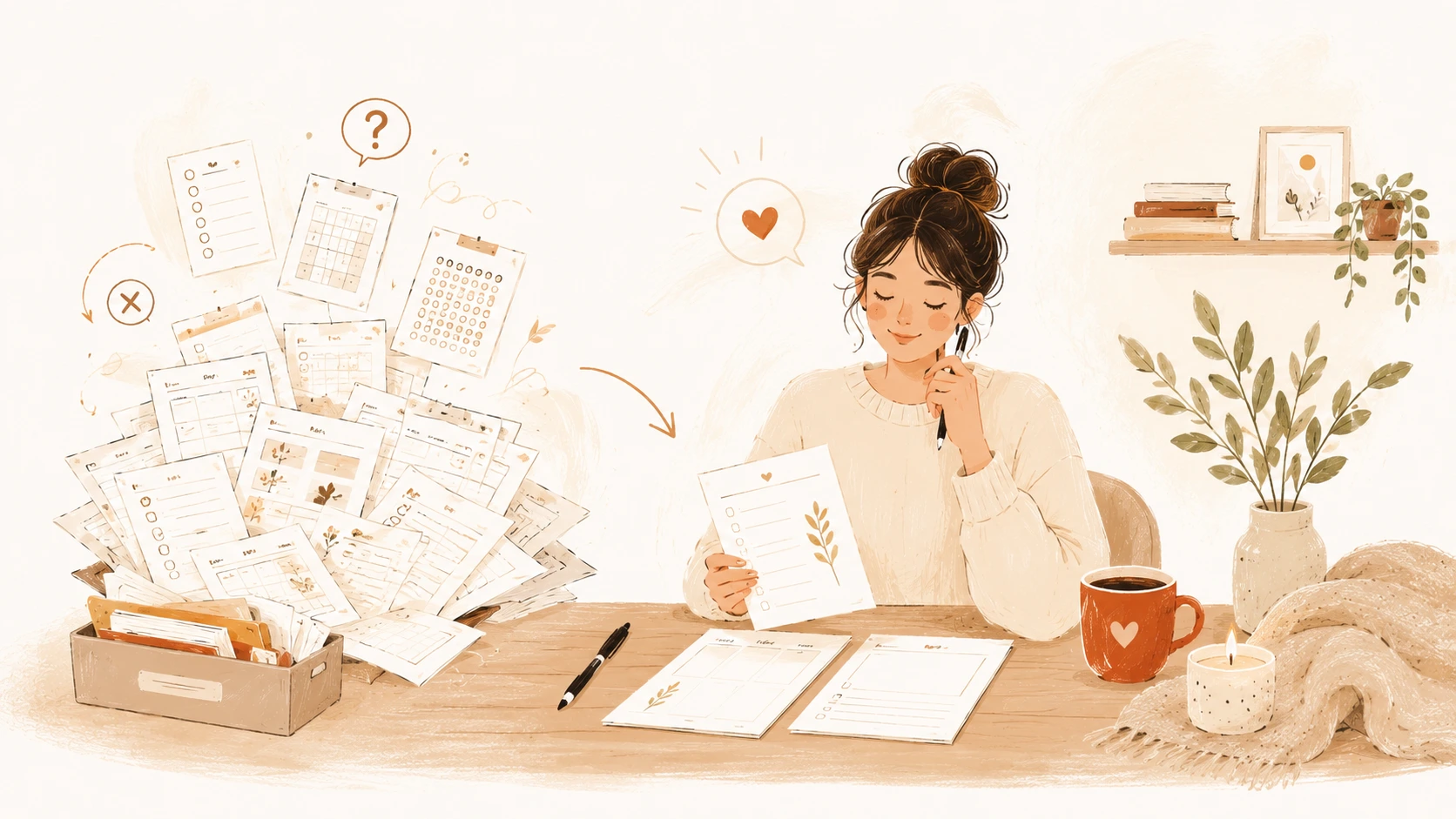
How to Use Printables Without Turning Your Life Into Homework
Printables are supposed to make everyday life easier, not give you another stack of pages to keep up with. A weekly planner, meal page, budget sheet, routine checklist, or home binder printable can be genuinely helpful, but only when it fits the way you actually live. When every page starts to feel like an assignment, the system has become too heavy.
The best printable setup is not the one with the most pages. It is the one you return to because it helps. A useful page gives information a place to land, makes a decision easier, or helps you remember something important. It should not make you feel behind, guilty, or like you need to become a perfectly organized person before you can use it.
Printables work best when they are treated as tools, not tests.
Why printables can start to feel like homework
A printable can feel exciting at first. You download a planner bundle, print the pages, set up the binder, and imagine how much clearer everything will feel. There may be a weekly page, daily page, meal planner, cleaning checklist, habit tracker, savings chart, goal sheet, journal page, password tracker, routine card, and monthly review.
Individually, each page may be useful. Together, they can become too much.
The problem is not the pages themselves. The problem is expecting every helpful-looking page to become part of your daily life. A printable that supports one person may be unnecessary for someone else. A habit tracker may motivate one reader and discourage another. A detailed cleaning schedule may help one household and overwhelm another.
When a printable starts asking for more attention than it gives back, it begins to feel like homework. You are no longer using the page because it helps. You are filling it in because you feel like you should.
That is the moment to simplify.
You do not have to use every page in a bundle
Printable bundles can be useful because they offer options. But a bundle is not a checklist of pages you are required to use. It is more like a menu.
You might download a home organization set and only use the emergency contact page, the weekly meal planner, and the password reminder sheet. That is enough. You might buy a planner bundle and ignore the daily pages because weekly planning works better for you. You might print a budget page for one month and then stop because it gave you the information you needed.
This is not failure. It is good editing.
A printable page earns its place by being useful. If it does not solve a real problem, it can stay in the file. You do not need to print it just because it exists. You do not need to create a full binder because the download includes enough pages for one. You can choose the pieces that fit your current season and leave the rest for later.
Start with the problem, not the printable
A good way to avoid overwhelm is to begin with the part of life that feels messy. Then choose one page to support it.
If dinner decisions are the stressful part, try a meal planning page. If your mind feels crowded, print a brain dump page. If mornings are rushed, use a school checklist or routine card. If money feels hard to track, begin with a simple money in/out sheet. If you keep losing important information, create one home binder page for contacts, warranties, or logins.
This keeps printables practical. You are not building a system for the sake of having a system. You are choosing a page because it answers a need.
It also prevents the common habit of adding pages because they look nice. Pretty pages can be enjoyable, but the useful question is: what will this help me do?
If you cannot answer that clearly, you may not need the page right now.
Let some pages be temporary
Not every printable has to become a permanent routine. Some pages are most useful for a short season.
A packing list might be needed for one trip. A holiday gift tracker might only matter for a few weeks. A school checklist may be useful during the first month of the school year, then become unnecessary once the routine settles. A reset checklist may help during a stressful week and then sit unused for a while.
That is fine.
Temporary pages are still useful. A page does not need to become a lifelong habit to be worth printing. It can help you through a busy week, a move, a holiday, a project, a school transition, or a season where your mind feels full.
This mindset takes pressure off. You can use a page when it helps and stop when it no longer does. The printable is there to serve the situation, not to become another obligation.
Choose pages that match your energy
A planning page may look simple when you are rested, but feel impossible when you are tired. This matters because many people reach for printables during busy or overwhelming seasons.
If your energy is low, choose pages that ask very little from you. A plain brain dump page may be better than a detailed planner. A short priority list may be better than a full daily schedule. A simple meal idea list may be better than a complete meal planning workbook.
Some pages require daily attention. Others only need a weekly check-in. Some pages ask you to track details. Others simply hold information. Be honest about the amount of attention you can realistically give.
A printable should meet your energy, not argue with it.
If a page makes you feel tired before you begin, it may be too detailed for the moment. That does not mean it is a bad page. It may simply be the wrong page for today.
Avoid using printables to chase a perfect version of yourself
It is easy to choose printables for the life you wish you had. The calm morning routine. The perfectly planned meals. The tidy cleaning schedule. The balanced budget. The daily journaling habit. The weekly review with candles, tea, and quiet.
Those things can be lovely, but real life may look different. Mornings may be loud. Dinners may need to be simple. The budget may be checked in quick notes. Cleaning may happen in small bursts. Planning may happen at the kitchen counter while someone asks where their shoes are.
A useful printable should fit the real version of your life. It should work on ordinary days, not only ideal ones.
If you keep abandoning pages, ask whether they were designed for your actual routine or for a fantasy routine. Maybe you do not need a full daily planner. Maybe you need one weekly overview on the fridge. Maybe you do not need a cleaning binder. Maybe you need a 10-minute reset checklist. Maybe you do not need five trackers. Maybe you need a single notes page where reminders can land.
Choosing realistic pages is not lowering your standards. It is making the system more likely to help.
Keep the setup small
A small printable setup is often easier to maintain than a large one. You might begin with three pages: this week, meals, and notes. Or today’s list, money in/out, and a brain dump page. Or a home binder with only emergency contacts, passwords, and warranties.
The smaller the setup, the easier it is to restart.
A large binder can be helpful, but only if it is truly being used. If a binder becomes a place where unused pages go to sit, it may be too much. A clipboard, folder, or small stack of printed pages can be just as effective.
Try using one or two pages for a couple of weeks before adding more. Notice what you reach for naturally. Notice what you ignore. The ignored pages are giving you useful information. They may not fit your needs, or they may need to be simpler.
Let the system grow slowly from real use.
Leave blanks without guilt
Blank spaces can make people feel like they are doing something wrong. An empty habit tracker, unused notes box, skipped daily page, or unfinished checklist can look like failure if you treat the printable as a scorecard.
But blank space is not a problem. It can mean the section was not needed. It can mean the day changed. It can mean the page had more room than you required. It can mean you used the part that helped and ignored the rest.
That is allowed.
You do not have to fill every box to benefit from a printable. If the weekly page helped you remember appointments but the meal section stayed blank, the page still helped. If a budget tracker made you notice one subscription but you did not finish the whole month, that insight still counts. If a brain dump page held messy thoughts for ten minutes and then was recycled, it did its job.
The page is not there to be completed perfectly. It is there to support you.
Make printables easy to reach
A printable that is hard to find will probably not be used. Keep the pages you rely on in a simple, visible place.
That might be a clipboard on the kitchen counter, a folder in your planning corner, a binder on a shelf, a fridge page, a desk tray, or a digital folder on your tablet. The right place depends on when and where you use the page.
Meal planning pages often belong near the kitchen or grocery list. Morning routine cards belong near the morning routine. Budget pages may belong at a desk or wherever bills are handled. Home reference pages belong somewhere trusted household members can find them.
The goal is to reduce friction. You should not need to search for your planning tools before you can start planning.
Reprint instead of catching up
One of the best things about printable pages is that you can begin again easily. You do not have to catch up on missed days. You do not have to fill in the blank pages from last week. You do not have to explain why the habit tracker stopped halfway through the month.
You can print a fresh page and start where you are.
This is especially helpful for people who feel discouraged by traditional planners. A bound planner can make missed weeks visible. A printable can be more forgiving. If a system pauses, you can restart with the page that helps most right now.
Reprinting is not wasteful if it helps you return to a useful routine. To reduce paper use, you can print only the pages you need, use grayscale, print in draft mode for everyday pages, or laminate pages that repeat often.
The important part is not maintaining a perfect streak. It is making the page available when it helps.
Let useful be enough
A printable does not need to be part of a complete life system to be worthwhile. It can help with one small thing. It can hold one list, one routine, one week of meals, one set of reminders, or one collection of scattered thoughts.
Useful is enough.
If a page makes the morning smoother, it matters. If a checklist helps you remember school items, it matters. If a notes page keeps your thoughts from floating around all day, it matters. If a weekly planner helps you see the shape of the week, it matters.
The purpose of printables is not to prove that you are organized. It is to make everyday details easier to manage.
A gentler way to use printables
Using printables well often means using fewer of them. Choose the pages that help, skip the ones that do not, and let your system change as your life changes. A printable can be temporary, imperfect, half-filled, reprinted, moved, simplified, or ignored until it becomes useful again.
You do not have to turn your home, schedule, budget, meals, and routines into a homework assignment. You can start with one page that solves one real problem.
That is where printables are most helpful: not as a perfect system, but as quiet support. A place to write things down. A way to see what matters. A small tool that makes the day feel a little less scattered.