
What to Print When Life Feels Scattered
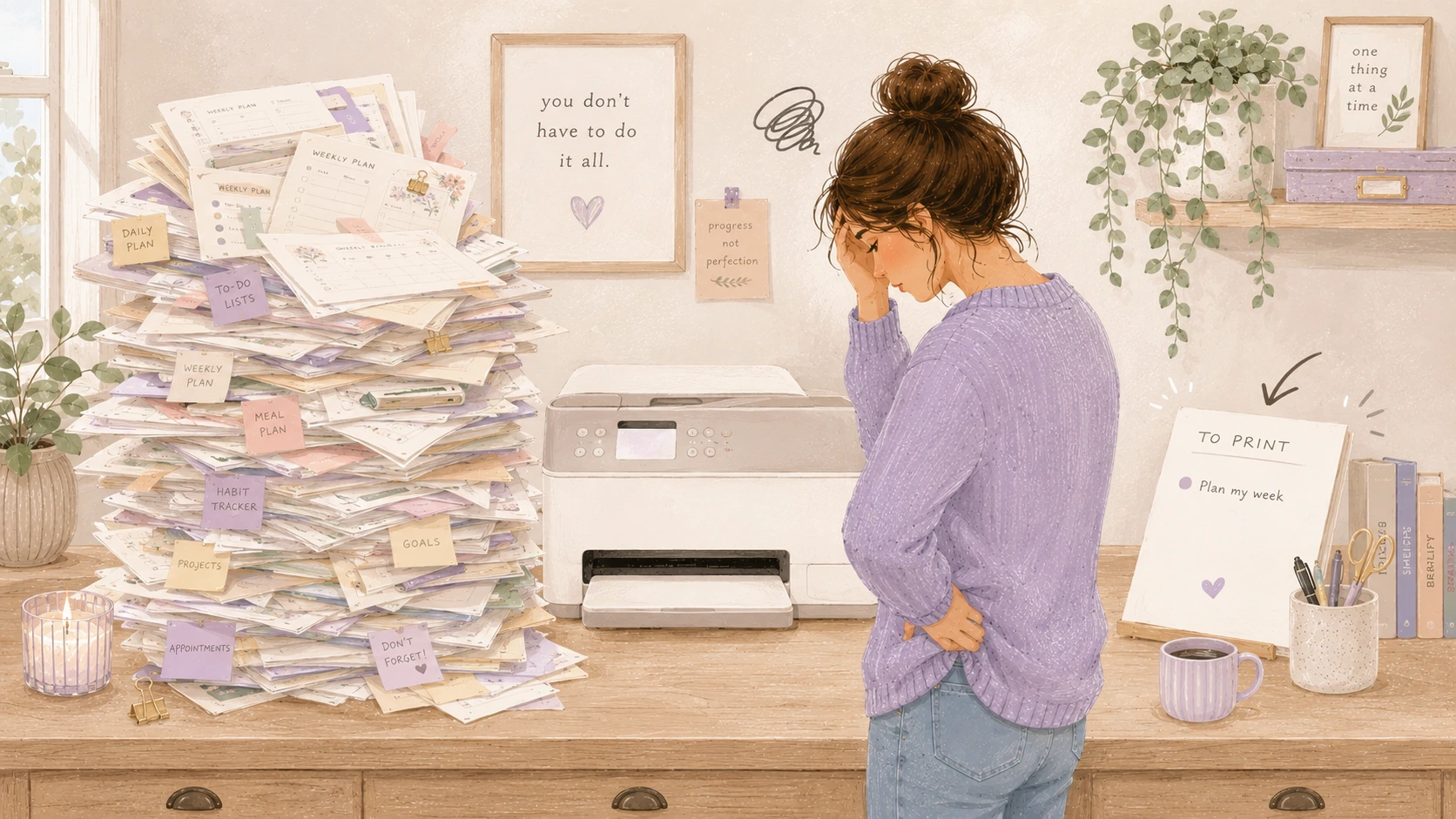
When life feels scattered, the problem is not always that there is too much to do. Sometimes the harder part is that everything is spread out. A reminder is in your head, an appointment is in your phone, a grocery thought is on a receipt, a bill is waiting in an email, and three unfinished tasks are sitting in different rooms.
That kind of scattered feeling can make even ordinary days feel heavier than they are. It becomes difficult to know where to start because every thought seems to arrive at once. You may not need a full planner, a new routine, or a complicated organizing system. You may only need a few simple printable pages that give your thoughts somewhere calm to land.
Brain dumps, priority lists, routine pages, and reset checklists are useful because they do not ask you to solve everything immediately. They help you collect, sort, and choose. When life feels messy, that can be enough to make the next step clearer.
Start with a brain dump page
A brain dump page is one of the simplest things to print when your mind feels crowded. It is just a place to write everything down without organizing it first.
This matters because scattered thoughts often become more stressful when you try to hold them all at once. You remember laundry, a phone call, an overdue message, a school form, dinner, a birthday gift, a subscription, a return, a work task, and a pile of papers all in the same mental space. None of these things are necessarily huge, but together they create noise.
A brain dump page gives you permission to empty that noise onto paper. It does not need categories at first. Write the tasks, reminders, worries, ideas, appointments, errands, and loose thoughts as they come. The page can be messy. It can have crossed-out words and half-formed notes. That is part of its purpose.
The goal is not to make a beautiful list. The goal is to stop asking your mind to be the storage place for every detail.
Once everything is written down, you can begin to notice what actually needs action. Some items may be urgent. Some may be small. Some may be emotional clutter rather than practical tasks. Some may not matter anymore. Seeing them on paper can make them feel less tangled.
Use a priority list to choose what matters now
After a brain dump, it can be tempting to turn everything into one long to-do list. That usually brings the overwhelm right back. A priority list helps by asking a smaller question: What matters now?
A useful priority page does not need many sections. It might include space for three main priorities, a few smaller tasks, and a short notes area. Keeping it limited is part of what makes it work. If every task becomes a priority, the page stops helping.
When life feels scattered, choosing three priorities can be more practical than trying to plan the whole day. These priorities might be time-sensitive, necessary for the household, connected to someone else waiting on you, or important for your own peace of mind. Paying a bill, making a medical appointment, preparing dinner, returning a school form, or finishing one work task might belong here.
The priority list also helps separate “important” from “loud.” Some tasks feel urgent because they keep popping into your mind, but they may not actually need to happen today. Others are quiet but important, like renewing a document, answering a message, or checking a calendar before a deadline arrives.
A printable priority page gives you a place to make that decision gently. It does not erase everything else. It simply helps you choose what deserves attention first.
Print a simple routine page when days feel uneven
Scattered seasons often disrupt routines. Mornings feel rushed. Evenings become reactive. Meals happen late. Small household tasks get skipped until they become bigger tasks. A routine page can help bring back a basic rhythm without creating a strict schedule.
A routine page is not the same as a perfect daily timetable. It is more like a reminder of the small steps that help the day run better. A morning routine might include taking medication, packing lunches, checking the calendar, starting laundry, or setting out what needs to leave the house. An evening routine might include dishes, resetting bags, choosing clothes, checking tomorrow’s appointments, and writing a short list for the morning.
The reason routine pages help is that they reduce repeated decision-making. When you are already tired or distracted, it can be hard to remember what needs to happen next. A printed routine page gives you a familiar path to follow.
Keep the routine realistic. If your mornings are busy, do not create a page with twelve steps. Choose the few actions that make the biggest difference. If evenings are unpredictable, make the routine flexible enough that you can do part of it and still benefit.
A good routine page should feel supportive, not demanding. It should help you return to the basics when the day feels loose around the edges.
Use a reset checklist when the house feels behind
A reset checklist is helpful when the space around you starts to reflect the scattered feeling inside your head. Counters collect papers. Laundry waits in baskets. Groceries need sorting. The fridge has mystery leftovers. Shoes, bags, mail, and small objects land wherever there is room.
A reset checklist does not mean deep cleaning the whole house. In fact, it works better when it is focused. A simple reset page might include clearing surfaces, collecting trash, starting one load of laundry, putting dishes in the dishwasher, planning one meal, sorting urgent papers, and setting out what is needed for tomorrow.
The checklist gives you a starting point when everything seems to need attention. Instead of walking from room to room noticing problems, you can follow a short sequence. This reduces the mental effort of deciding what to do next.
It can also help to create different reset checklists for different moments. A 10-minute reset might focus only on visible clutter and tomorrow’s needs. A Sunday reset might include meals, appointments, errands, and laundry. A monthly reset might include bills, subscriptions, paperwork, and household maintenance.
The best reset checklist is one you can actually finish or partly finish. It should leave you feeling steadier, not disappointed that you did not clean every corner of your home.
Match the page to the kind of scattered you feel
Not every scattered day needs the same printable. Choosing the right page can make the system feel lighter.
If your thoughts are racing, print a brain dump page. If you have too many tasks and cannot decide where to begin, print a priority list. If the day keeps slipping away from you, print a routine page. If your home feels messy and you do not know where to start, print a reset checklist.
This is one reason printable pages can be more useful than a full planner during overwhelming seasons. You do not have to commit to a whole system. You can choose the page that fits the problem in front of you.
Some days, a brain dump will be enough. Other days, you might use a brain dump first, then pull three items onto a priority list. On a weekend, you might use a reset checklist to bring the house back to a more manageable place. During a busy school or work season, a routine page might be the most helpful because it keeps the basics visible.
The pages can work together, but they do not have to be used all at once.
Keep the pages plain enough to use
When life feels scattered, overly detailed pages can make things worse. Too many boxes, categories, trackers, and decorative sections can create the feeling that you now have another project to manage.
Plain pages are often better for scattered moments. A brain dump needs open space. A priority list needs limits. A routine page needs clear steps. A reset checklist needs simple actions. The design should make the next step easier to see.
This does not mean the pages have to be unattractive. A calm, clean printable can still feel pleasant to use. But the page should not ask for more energy than you have. If you find yourself avoiding a printable because it feels like too much, it may need to be simpler.
White space can be useful. Large writing areas can be useful. Short lists can be useful. A page does not need to look full to be doing its job.
Give every page a clear purpose
A printable page works best when you know what it is for. A brain dump is for collecting. A priority list is for choosing. A routine page is for repeating. A reset checklist is for restarting.
This helps prevent the pages from becoming one more pile of paper. If a page has a clear purpose, you are more likely to reach for it at the right time. You are also less likely to expect one page to solve everything.
For example, a brain dump page may look messy and unfinished because its job is to hold loose thoughts. A priority list should be shorter because its job is to help you focus. A routine page may stay the same for weeks because its job is to remind, not change. A reset checklist may be reused because its job is to help you return to a basic level of order.
When each page has its own role, the system stays simple.
Make the pages easy to reach
Printable pages are most useful when they are available before you feel completely overwhelmed. Keep a few copies somewhere easy to access. That might be in a home binder, on a clipboard, in a desk drawer, inside a planner cover, or in a folder near the kitchen.
You might keep a small “reset stack” with one brain dump page, one priority page, one routine page, and one reset checklist. When the day starts to feel scattered, you can pull out the page that fits instead of searching for a notebook or opening multiple apps.
If you prefer digital tools, keep the printable PDFs in a clearly labeled folder on your tablet or computer. The same idea applies: the page should be easy to find when your brain is already full.
A system that is hard to access will not be used often. A system that is simple and nearby has a better chance of becoming a quiet support.
Do not turn the reset into another pressure point
It is easy to take a calming tool and accidentally make it strict. You may print a reset checklist and feel like you must finish every item. You may write a priority list and feel bad if only one thing gets done. You may create a routine page and feel like the day failed if the routine was interrupted.
That is not the purpose of these pages.
A printable is there to help you return to yourself and your surroundings with a little more clarity. It is not there to measure your worth or prove that you are organized. Some days, writing the brain dump is the helpful part. Some days, choosing one priority is enough. Some days, resetting one counter or one basket of laundry changes the whole feeling of the room.
Use the pages as support, not a test.
A softer way to restart
When life feels scattered, it can be tempting to search for a complete new system. But often, the most helpful tools are the simplest ones. A brain dump page gives your thoughts a place to land. A priority list helps you choose what matters now. A routine page brings back a little rhythm. A reset checklist gives you a practical starting point when the house or the week feels messy.
These pages will not make life perfectly organized, and they do not need to. Their value is smaller and more realistic. They help you pause, gather what is loose, and take the next step with less noise around it.
A few printed pages can create a gentle way back into the day. Not by forcing everything into order, but by giving scattered details a calm place to go.